





Tower Rush
Tower Rush is a 2024 Fast Game from Galaxsys that turns the classic tower-stacking format into a crash-style betting game. Each floor you place raises a multiplier; you decide whether to bank the current amount or risk it on the next floor. The game is available at 1Win and other Galaxsys-powered platforms, running on an RTP of 96.12–97%, with wins capped at 100x or $10,000, and three randomized bonus mechanics — Frozen Floor, Temple Floor, and Triple Build — that set it apart from straightforward crash titles like Aviator.
It suits players who enjoy quick, decision-driven rounds and don’t mind that outcomes are fully random. It’s not a fit for anyone looking for skill-based mechanics or higher multiplier ceilings — Tower X, for instance, goes up to 5,000x.
Editorial rating: ★★★★☆ (4/5)
Quick Facts
| Parameter | Value |
|---|---|
| Developer | Galaxsys |
| Release | 2024 |
| Game Type | Crash / Tower-building |
| RTP | 96.12% – 97% |
| Volatility | High |
| Max Win | 100x or $10,000 |
| Min/Max Bet | $0.01 – $100 |
| Demo Mode | Yes |
| Mobile | Yes (HTML5, browser-based) |
| Provably Fair | Yes |
Editor Verdict
Good for: players who like fast rounds, want full control over cashout timing, and appreciate transparent fairness verification.
Not for: players chasing five-figure multipliers, or anyone who wants automated tools like Auto Cashout or Autoplay — Tower Rush doesn’t have either.
Our take: Tower Rush does enough differently from a standard crash game — mainly through its three bonus mechanics — to be worth a session or two, but the 100x cap and lack of autoplay keep it from being a top-tier pick for high-volume players.
What Tower Rush Actually Is
Tower-stacking arcade games existed long before gambling got involved — the genre dates back to mobile and Flash titles where you simply tried to stack blocks as high as possible without missing. Galaxsys took that format and attached a crash-game payout curve to it: instead of a fixed end state, every successful floor placement is itself a cash-out decision point.
This puts Tower Rush in a different lane from Aviator, which only has one variable — the multiplier curve — and one decision — when to cash out. Tower Rush adds a second layer: floor-by-floor bonus triggers that can independently boost a round regardless of when you stop.
Compared to Tower X (Smartsoft Gaming), the more direct competitor in this niche, Tower Rush trades a much higher win ceiling (5,000x on Tower X vs. 100x here) for added bonus variety. Galaxsys appears to have built the game around steadier, more frequent payouts rather than rare, massive ones.
How Tower Rush Works
The round structure follows a fixed loop:
Set stake → Build (drop floor) → Floor lands → multiplier updates → Cash Out or Build again → (repeat until cashout or crash)
A round ends in one of two ways: you cash out and bank the current multiplier value, or a floor fails to land and you lose the stake plus everything accumulated in that round.
Gameplay Breakdown
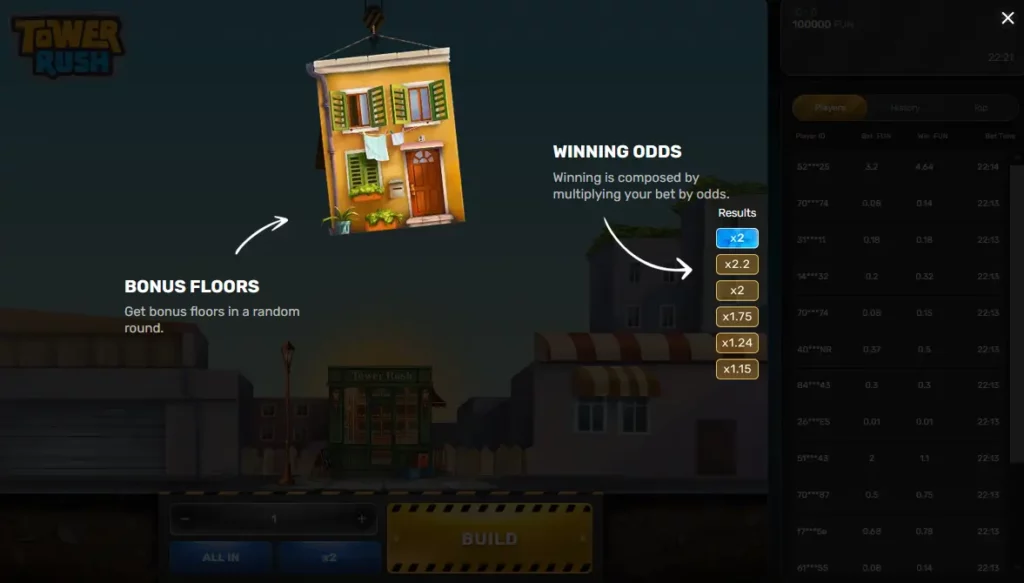
Tower Rush Tutorial
Setting the stake. The bet field accepts $0.01–$100. A “x2” button doubles the previous stake instantly, mainly useful for progressive betting approaches.
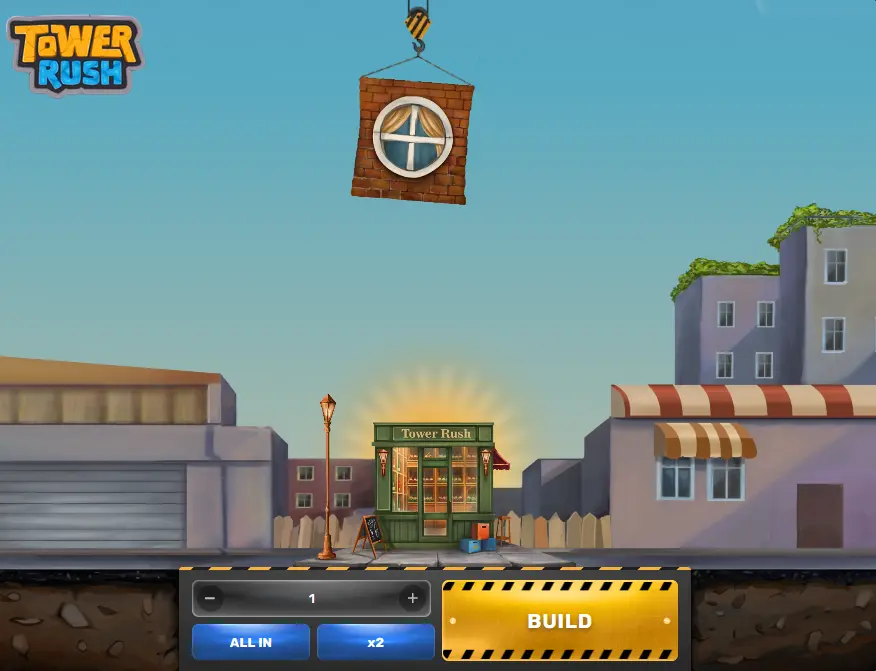
Tower Rush Start Game
Starting the round. Pressing “Build” drops the first floor. There’s no waiting period or animation buildup — the placement resolves almost immediately.
Floor placement. Each landed floor carries its own multiplier value, generated independently. There’s no visible pattern across floors — early floors aren’t reliably “safer” than later ones in terms of the per-floor odds, even though cumulative risk obviously rises the longer you build.
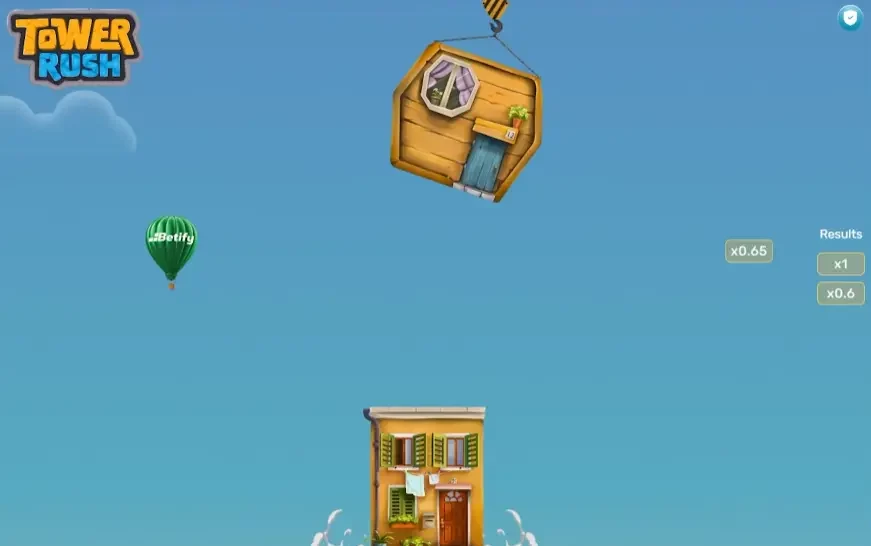
Success in Tower Rush
The cashout decision. After every successful floor, the interface shows two options: Cash Out (lock in current winnings) or Build (continue). This is the only real decision point in the entire game.
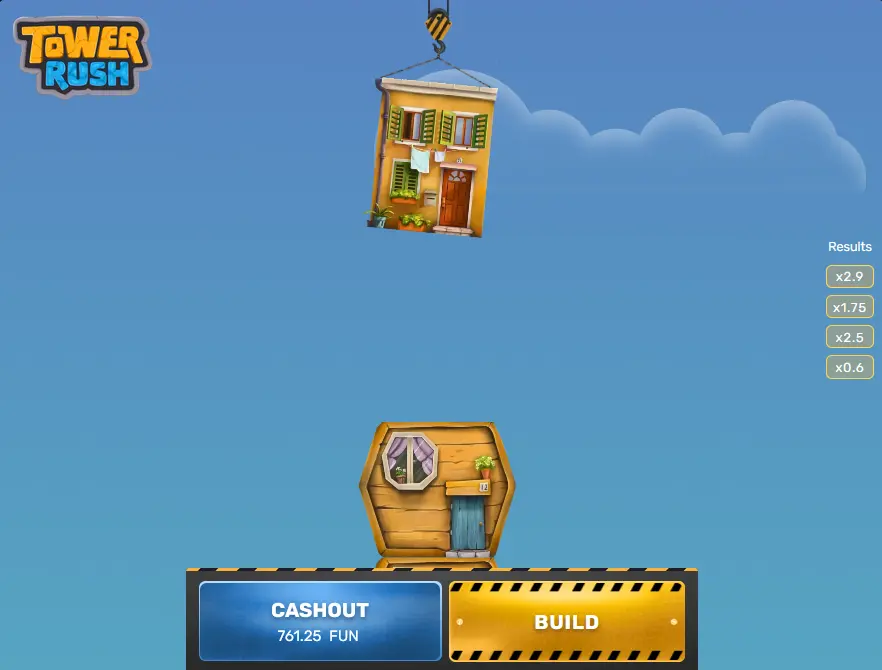
Cash Out, Build Buttons
Round resolution. A failed floor placement ends the round immediately — stake and accumulated multiplier are both lost. There’s no partial recovery.
Bonus Mechanics
Frozen Floor
What it does: Locks in your current winnings permanently, even if later floors crash. When it appears: Randomly, disguised as a normal floor — you don’t know it’s Frozen until it lands. When it’s valuable: Mid-to-late in a round, when accumulated winnings are meaningful and you’d otherwise be nervous about continuing. Pros: Removes downside risk on the frozen amount entirely; you can keep building risk-free above it. Cons: Can’t be triggered intentionally — purely random, and only once per round.
Temple Floor
What it does: Triggers a 10-section bonus wheel with multiplier values (x1.5, x2, x3, x5, x7 — each appearing twice — plus a Frozen Floor result). When it appears: Randomly, on any floor. When it’s valuable: Anytime — it applies on top of your existing winnings, so there’s no real downside to landing it. Pros: Can occur multiple times in one round; stacks with normal floor multipliers. Cons: Outcome is fully random; you have no control over which wheel segment you land.
Triple Build
What it does: Adds three floors at once instead of one, each with its own multiplier. When it appears: Randomly, disguised as a regular floor. When it’s valuable: Early-to-mid round, since it accelerates height (and multiplier) without requiring three separate successful placements. Pros: Faster progression, can repeat within a round. Cons: Doesn’t reduce risk — you’re still exposed across three floors’ worth of crash probability, just compressed into one step.
RTP and the Math Behind It
An RTP of 96.12–97% means that, across a very large number of rounds, the game returns that percentage of total wagers to players collectively — it says nothing about any individual session, which can deviate enormously in either direction.
The reason the RTP is presented as a range rather than a single number is that some operators run slightly different configurations of the same Galaxsys engine, and bonus-feature frequency can shift the effective return rate within that band. Strategy doesn’t change the underlying RTP — no cashout timing or betting pattern alters the per-floor probability — but it does change your personal variance: cashing out early reduces both your average loss streak length and your average win size.
A common misconception is that RTP guarantees a return within any given session, or that a “cold” game is “due” for a win. Neither is true under Provably Fair random generation — each floor placement is an independent event.
Volatility Explained
Tower Rush is classified as high volatility, meaning wins are less frequent but can be considerably larger relative to stake when they land. In practice:
- A 2x result happens often enough to feel routine
- A 5x result requires building past the point most players cash out
- A 20x result is uncommon and typically involves at least one bonus trigger
- A 50x+ result is rare and usually combines several bonus events in a single round
This volatility profile is why the Frozen Floor bonus matters more than it might first appear — it’s one of the only mechanics that reduces variance rather than adding to it.
Provably Fair: How It Actually Works
Provably Fair is a verification method that lets you confirm a result wasn’t altered after the fact, without needing to trust the operator’s word for it. It works through three components:
Server Seed — generated by the game server before the round starts, kept hidden (hashed) until after the round resolves. Client Seed — a value you can influence or that’s generated for your session. Hash — a cryptographic fingerprint of the Server Seed, shown to you before the round, so the server can’t quietly change the outcome afterward.
After the round, the actual Server Seed is revealed. You (or a third-party checker) can hash it yourself and confirm it matches the hash shown before the round — proving the server committed to that result in advance.
To check a real round: open the shield icon in the upper-right corner of the game window, copy the Key and Salt values shown, and run them through a SHA-256 verification tool. If the resulting hash matches what was displayed before the round started, the result wasn’t tampered with.
Demo vs. Real Money
| Demo | Real Money | |
|---|---|---|
| Currency | Virtual credits | Real balance |
| RTP/odds | Identical | Identical |
| Bonus features | Active | Active |
| Withdrawals | Not applicable | Available |
| Provably Fair | Verifiable | Verifiable |
Demo mode is functionally identical in terms of odds and feature frequency — there’s no difference in the underlying math. It’s useful for learning the cashout rhythm and seeing how the bonus features look before risking a stake, but it won’t tell you anything about long-run real-money outcomes that the RTP figure doesn’t already.
Mobile Experience
Tower Rush runs entirely in-browser via HTML5 — there’s no dedicated app on Android or iOS. On both platforms, the interface scales down cleanly, with the Build and Cash Out buttons remaining large enough for fast taps. Desktop offers marginally faster visual feedback on stable connections, but this isn’t a game where reaction-time latency matters much, since you’re never racing a fast-moving curve — each floor placement is a discrete event rather than continuous motion.
Interface Overview
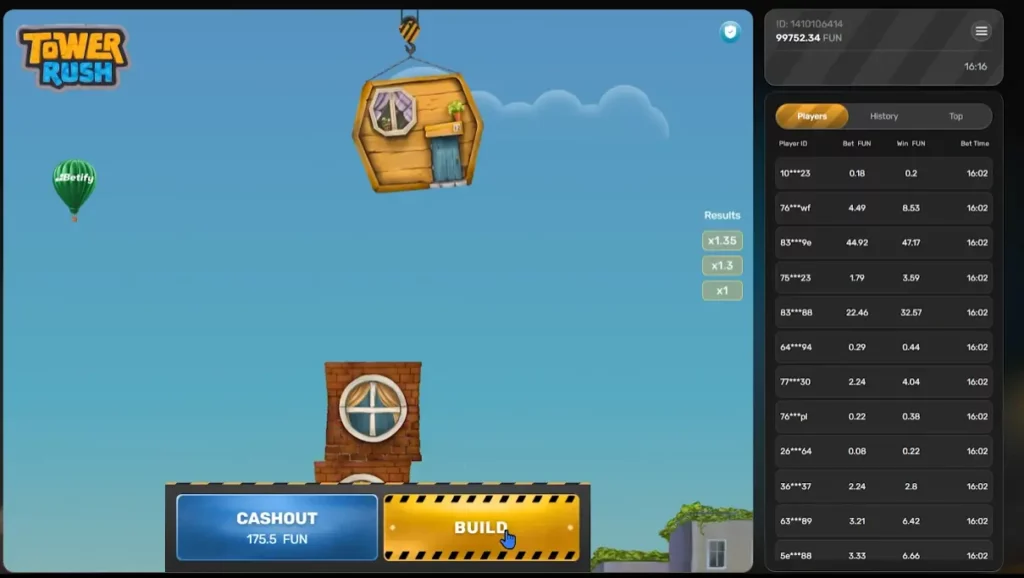
Tower Rush Gameplay
- Balance — top bar, constantly visible
- Round history — recent multiplier outcomes from your session and others
- Current multiplier — updates after each floor lands
- Build / Cash Out — the two primary action buttons
- Provably Fair shield icon — top-right, opens verification panel
Strategies
Conservative Cash out after 3–5 successful floors, targeting 3x–5x. Lower variance, more consistent small wins. Use when: prioritizing bankroll preservation over big multipliers.
Balanced Mix of early cashouts on most rounds with occasional extended builds when a bonus has already landed. Use when: you want some upside exposure without consistently risking full accumulated winnings.
Aggressive Build well past typical cashout points, accepting that most rounds will end in a crash, chasing the rare high multiplier. Use when: bankroll can absorb a long losing streak and the goal is variance, not consistency.
What Not to Do: Martingale
Doubling your stake after every loss (using the “x2” button) doesn’t change the underlying probability of the next floor crashing — it only increases how much you lose when a losing streak continues, which is just as likely after ten losses as after one. Because Tower Rush has no per-round win guarantee and losing streaks of significant length are mathematically unsurprising at this volatility level, Martingale here is a fast way to hit a bankroll’s loss limit, not a strategy that improves odds.
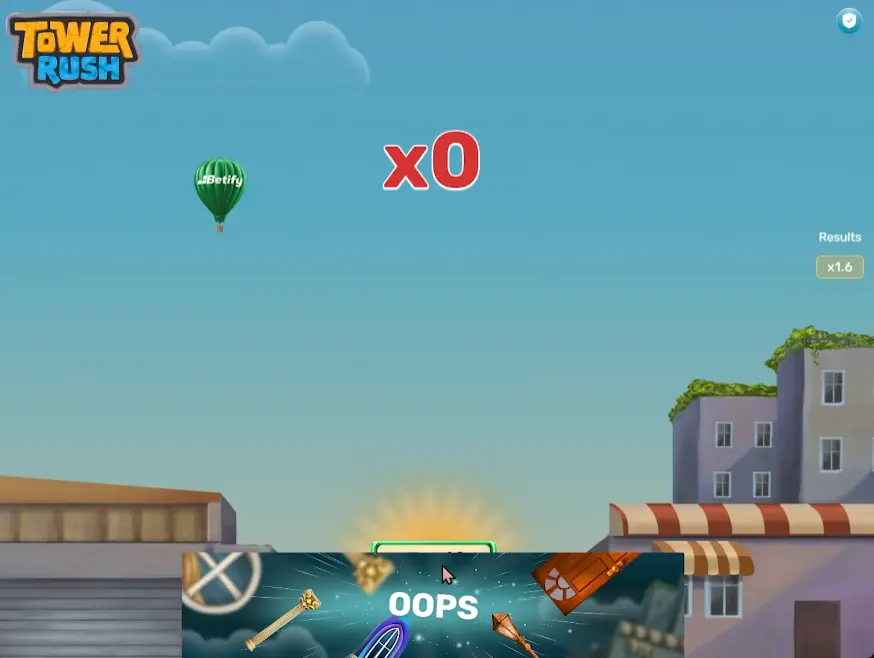
Ending Game Tower Rush
Common Beginner Mistakes
- Cashing out too late — chasing one more floor after already reaching a comfortable multiplier, then losing it all to a crash
- Immediately rebuilding after a loss — chasing losses with bigger or faster bets instead of resetting and reassessing
- Ignoring Frozen Floor value — continuing to build aggressively right after a Frozen Floor lands, risking the unfrozen portion without weighing whether it’s worth it
- Betting the full bankroll on one round — the “All In” button carries no special odds advantage; it’s simply a higher-stakes version of the same random outcome
How Tower Rush Compares
| Game | RTP | Max Win | Demo | Bonus Features | Provably Fair | Mobile |
|---|---|---|---|---|---|---|
| Tower Rush | 96.12–97% | 100x | Yes | 3 | Yes | Yes |
| Tower X | ~97% | 5,000x | Yes | Auto Cashout/Autoplay | Yes | Yes |
| Aviator | ~97% | Uncapped | Yes | None | Yes | Yes |
| JetX | ~97% | 1,000,000x | Yes | None | Yes | Yes |
| Spaceman | ~96–97% | 5,000x | Yes | None | Yes | Yes |
Tower Rush sits at the lower end of this group on raw win potential, but it’s the only one in this comparison offering three distinct bonus mechanics rather than a single multiplier curve.
Pros and Cons
Pros:
- Three genuinely different bonus mechanics, not just cosmetic variants
- Provably Fair verification is accessible and explained on-screen
- Low minimum bet ($0.01) makes it approachable
- Frozen Floor meaningfully reduces variance when it lands
Cons:
- 100x/$10,000 win cap is low relative to genre competitors
- No Autoplay or Auto Cashout — every round requires manual input
- Outcomes are entirely luck-based with no skill component
- High volatility means losing streaks can run long before a meaningful win
Conclusion
Tower Rush works well for players who want a fast, decision-driven crash game with some structural variety beyond a single rising curve — the three bonus mechanics, especially Frozen Floor, add a layer that pure curve-based games like Aviator don’t have. It’s a weaker pick for anyone chasing large multipliers or wanting automation tools, since both the win cap and the lack of Autoplay put it behind direct competitors like Tower X. After going through the mechanics and fairness verification in detail, the game holds up as legitimate and reasonably transparent — just not the highest-ceiling option in its category.
 Oliver Bridgewater